
The global business process outsourcing market is expected to reach USD 695.77 billion by 2033, growing at 9.9% a year. Much of that work is outsourced: a partner in another country handling part of your business.
Support leaders ask themselves if it’s practical. How do you ensure quality while keeping costs and hours down with offshore customer support?
This guide covers the fundamentals of offshore customer support outsourcing, how it differs from other types of outsourcing, the costs, common pitfalls, and how to choose a partner.
Looking to compare? Get an estimate for your support program.
Key Takeaways
- Offshore outsourcing is when a company in another country performs work for a business under contract.
- Our data show offshore savings rates of 60-80% of support costs when the model fits.
- The main risks are language barriers, quality issues, data security concerns, time zones, and hidden fees.
- Practical solutions exist for every risk, such as a pilot, shared scorecards, and clear contract terms.
- Offshore teams prefer consistent, predictable support, which clear processes and ample service hours provide.
What Is Offshore Outsourcing?
Offshore outsourcing involves hiring a service provider from a different country (usually far away) to do a certain aspect of the business. The provider supplies personnel, procedures and equipment. The client sets the goals, benchmarks and budget and holds the provider accountable for compliance.
Well, how does offshore outsourcing work in the real world? So there’s a Toronto eCommerce company that’s in need of 24/7 help. Instead of hiring night staff at home, they sign with a provider whose team is in the Philippines.
Manila is 12 to 13 hours ahead of Toronto (this time may vary due to daylight saving time). This means the offshore team works Canadian nights, which is their day.
The phrase offshore sourcing may be used, too. For those who ask “what is offshore sourcing,” they are looking for an outsourcing solution rather than a local build solution. It’s not work for hire. It is structured, with designated personnel, procedures, and service levels.
Our outsourcing vs. in-house teams guide is the bigger build-or-buy decision.
How Does Offshore Outsourcing Work?
Most programs follow the same seven steps. Skipping one is the most common reason a launch disappoints.
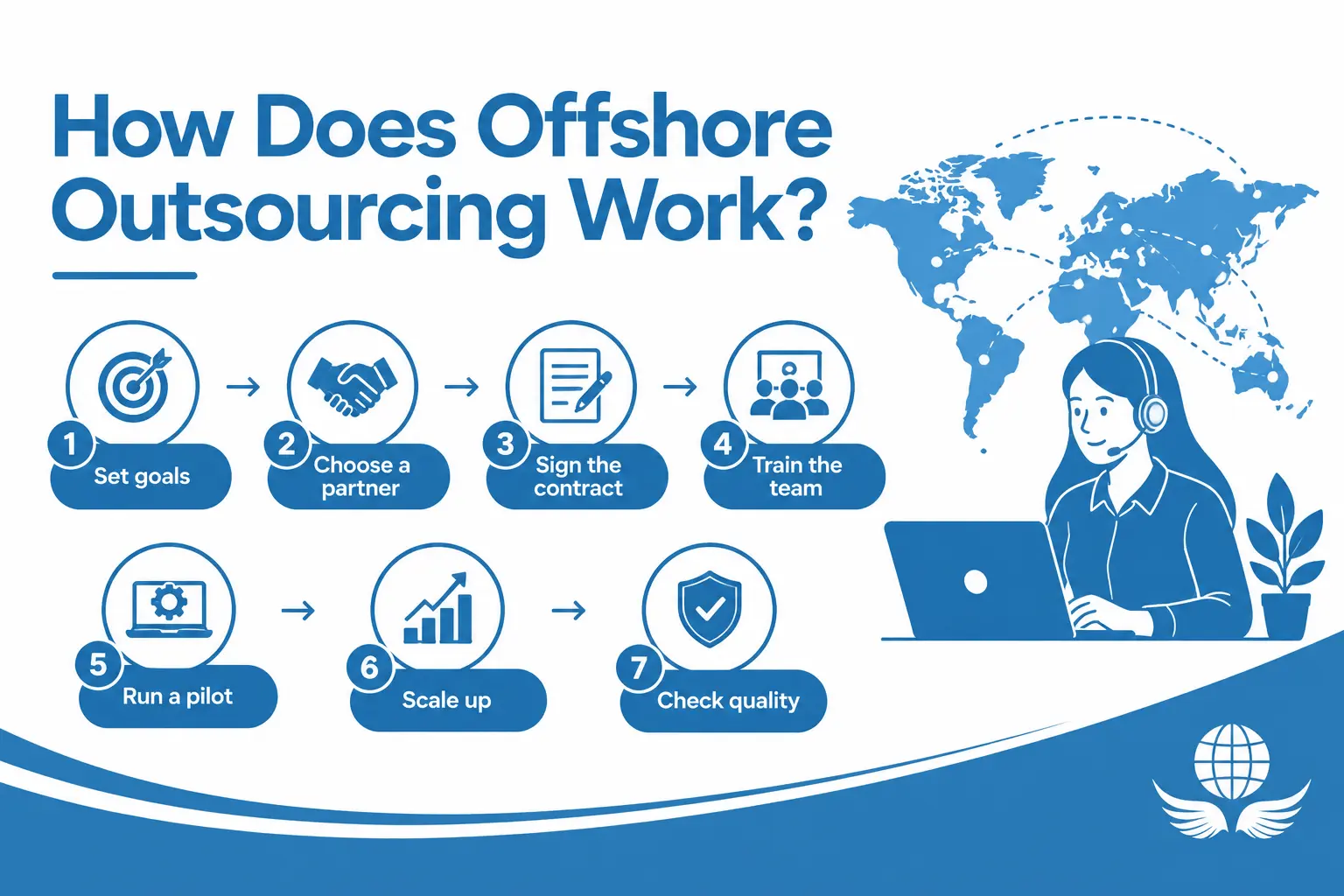
- Set goals: Define channels, hours, languages, and targets such as answer speed and resolution rate.
- Choose a partner: Shortlist providers based on languages, security and years of support.
- Sign the contract: Agree in writing on service levels, pricing, data protection terms, and exit rules.
- Train the team: Train agents on your products, tone, and systems before they take live contacts.
- Run a pilot: Begin with one queue or channel and track progress toward targets.
- Scale up: Assign agents, hours/language after the pilot has met targets.
- Check quality: Review calls, scorecards, and customer feedback weekly, then make changes.
At Agents Republic, step four follows a set path. Candidates complete video interviews, Hogan assessments, background checks, and system tests. They then join orientation sessions and hands-on training on your tools. Agents must pass a final test before taking live calls. Our guide to outsourcing call centers walks through each stage in more depth.
Offshore vs Nearshore Outsourcing vs Onshore: Key Differences
The real choice is often offshore vs nearshore outsourcing, with onshore as the premium option. Each model involves a trade-off between cost and distance.
| Factor | Offshore | Nearshore | Onshore |
|---|---|---|---|
| Location | Distant country, such as the Philippines | Nearby country, such as Mexico | Your own country |
| Cost | Lowest | Moderate | Highest |
| Time zone | Large gap, ideal for overnight cover | Small gap, shared hours | Same time zone |
| Language | Strong English, wide choice of languages | Strong Spanish and English | Local language and accent |
| Best use | 24/7 support and steady, high-volume work | Real-time teamwork and Spanish support | Regulated or highly local work |
Offshore suits round-the-clock queues and repeatable work. Nearshore works well for teams that need overlap with head office. Onshore is appropriate when local laws, accents, or on-site work become critical factors.
Many brands mix the two models, such as offshore first contact with onshore escalations. Our article on nearshore Spanish call centers explains that model for Spanish support.
Offshoring vs Outsourcing: What Is the Difference?
The terms sound alike but describe different decisions. The difference between offshoring and outsourcing is where the work and workers are located.
| Term | What Changes | Example |
|---|---|---|
| Offshoring | The work moves to another country | Opening your own support office abroad |
| Outsourcing | Another company does the work | Hiring a local call center partner |
| Offshore outsourcing | Both change | Hiring a partner whose agents work abroad |
Offshore outsourcing combines the two. You get the lower cost of another country without establishing or maintaining your own foreign office.
Offshore Outsourcing Benefits for Customer Support
Most guides list these benefits for software teams. Here is how each one applies to offshore customer support outsourcing.
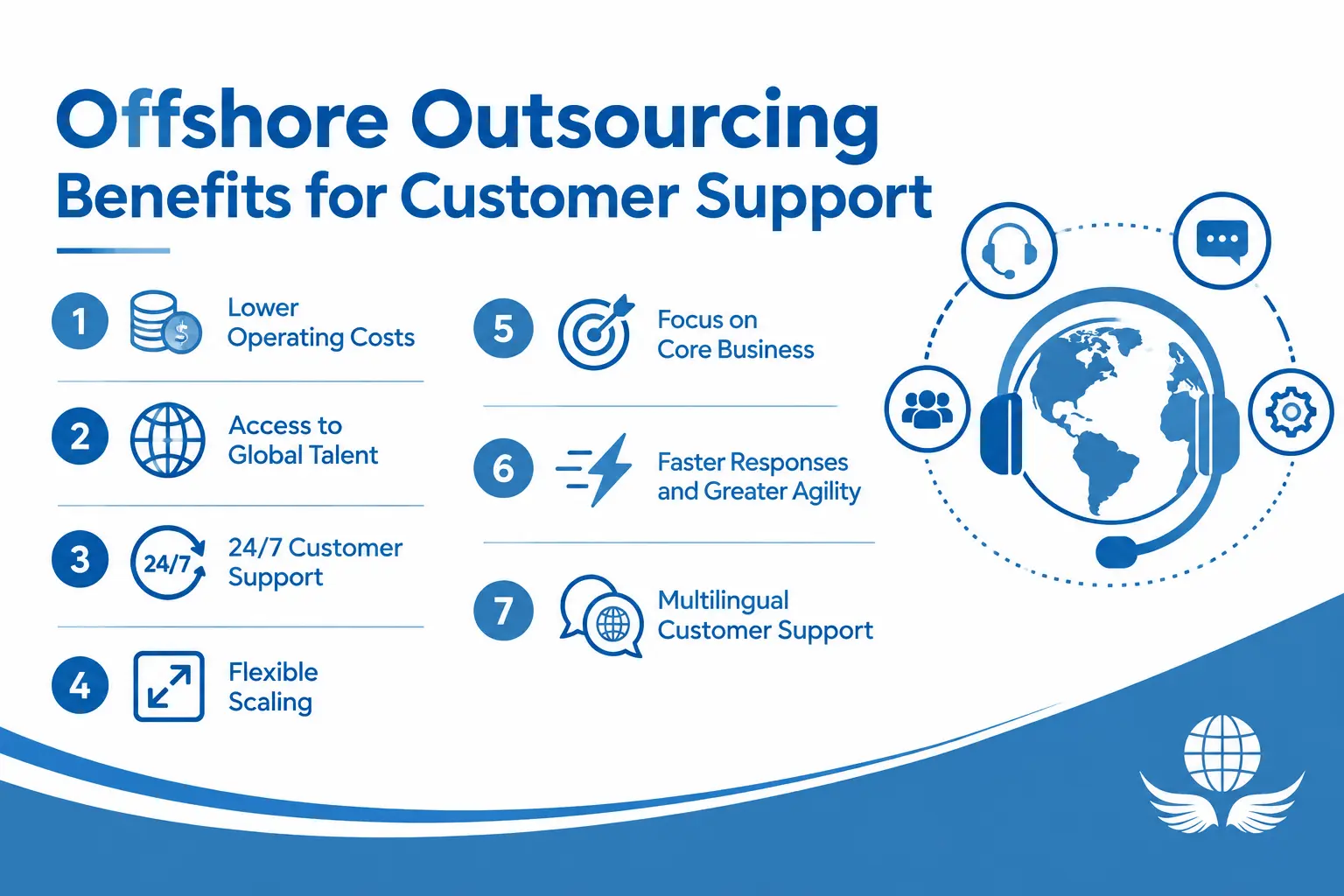
Lower Operating Costs
Labour costs are the largest component of any support programme budget. Our own analysis on how to reduce staffing costs puts offshore savings at 60 to 80%. These savings come from reduced payroll and shifting recruiting, benefits, and office expenses to the partners.
For instance, a retail outlet may have a full holiday support team rather than a smaller local team.
Leverage to a broader talent pool
Local jobs limit candidates to your area. An offshore partner can recruit from a much wider pool of trained agents. This is especially true for hard-to-fill roles, such as an agent with tech experience or a night shift lead.
For instance, a SaaS company that waits months for local staff can staff a Tier 1 help desk much sooner. We test all agents before they go live for product knowledge, tone, and systems. You can find out how wide that pool is on our multilingual customer service page.
Round-the-Clock Coverage
Time zone differences work in your favour. Your offshore team works as usual while your customers sleep. With a Canadian software company, your team can reply to tickets within hours, not the next morning. You don’t pay a premium night-shift rate at home. Your local team also works without a backlog every day, even if the queue is empty.
Increased Scaling on Peaks
Sudden spikes from launches, sales events, and outages. An established partner can introduce trained agents quicker than you can recruit. You can also scale back after the peak without shedding workers.
For example, if you run an internet-based business, you can hire double the staff for six weeks during the festive season, then reduce staffing back to normal afterward. We designed our scalable customer support solution for these swings.
Increase The Amount Of Core Work In Practice
No more shift swapping, hiring, or coverage gaps for your managers while they run daily support. They can concentrate on product, retention and growth. For example, a founder who used to handle night emails can return to sales and strategy. Your in-house experts can then focus on difficult cases that need their expertise.
Quick Responses And Agility
When contacts come in, more agents are on hand to assist, so wait times decrease with a well-managed offshore team. It also lets you test new channels (such as chat or SMS) before you commit.
For instance, a travel company can enable live chat throughout the busy season and disable it afterward if customers aren’t using it. That speed helps a brand enter new markets with less risk.
Multilingual Support
Offshore partners can staff native speakers from one program for multiple markets. A Canadian brand can direct customers in Asia and Europe to agents in the right language. Then one contract, one set of reports and one quality standard apply to each market.
Explore our French call center services, German call center services, Japanese call center services, Korean call center services and Mandarin call center services.
Offshore Outsourcing Risks and How to Manage Them
The risks of offshore outsourcing are real, but none should stop a well-planned program. Each has a handy solution.
Language and Accent Gaps
Customers quickly notice unclear words and odd phrases. A caller from Halifax might say something an agent elsewhere won’t understand.
Fix: Require native or near native speakers, test accents during hiring and review sample calls before launch. Provide agents with a “dictionary” of your product terms and common customer phrases.
Uneven Service Quality
Standards that only exist in your mind can wander. Small slips, such as skipped greetings or missed notes, add up over time.
Fix: Share one scorecard, review recorded calls weekly and run a pilot before you scale. Ask about the staff-to-student ratio. We average 17 agents per supervisor.
Data Security and Compliance
Offshore agents can handle names, account information, and card details. In 2025, the average global cost of a data breach was USD 4.44 million.
Fix: Ask for PCI DSS controls on card payments and GDPR controls for European customers. In Canada, your company remains responsible for personal information you provide to a third party for processing; include protection terms in the contract.
Time Zone Coordination
Decisions and escalations can be delayed due to a 12-hour gap. If it’s an urgent matter at 2am in Toronto, it could take hours to get a response.
Fix: Set aside a few hours a day to overlap, have written handover notes and designate one escalation contact per side. Develop guidelines for agents on what they can solve independently.
Hidden Costs
Extra charges can be concealed in the hourly rate. Typical other options include setup, tool licences, holiday hours, etc.
Fix: Request a written report of all fees, including set-up, training, tools and telecom. Look at the total cost for the month, not just the hourly price. For system links or extensive training, our own set-up costs apply, and telecom charges are billed at cost.
How Much Does It Cost to Outsource Offshore?
The prices offshore vary depending on the model, and the hours and skills you require. Our data shows offshore savings of 60 to 80% compared with local staffing, though your results depend on scope.
| Pricing Model | How It Works | Best For |
|---|---|---|
| Per hour | You pay for each agent hour worked or scheduled | Steady queues and fixed coverage |
| Per agent per month | A flat monthly rate for each full-time agent | Large, stable programs |
| Per transaction | A fee for each call, ticket or chat handled | Simple, predictable contacts |
Agents Republic has two models. Shared support is a minute-based answering service for simple English calls, with plans on our 24/7 answering service page. Dedicated support is billed by the hours you need covered: agent hourly rate × required hours, plus a fixed monthly fee for team leads.
Because dedicated billing follows coverage hours, a short month such as February usually costs less than a 31-day month. Before you sign, check what the price includes:
- Hiring, training and team leads
- Quality checks and reports
- Telephone lines and ticketing apparatuses
- Access to your CRM and knowledge base
- Costs for system links and/or long training setup
Our Erlang staffing calculator helps you determine how many agents you need. You can read more about pricing in our call center outsourcing cost guide.
Customer Support Services That You Can Outsource Offshore
There are 6 categories of offshore outsourcing support services. All are included in our call center services.
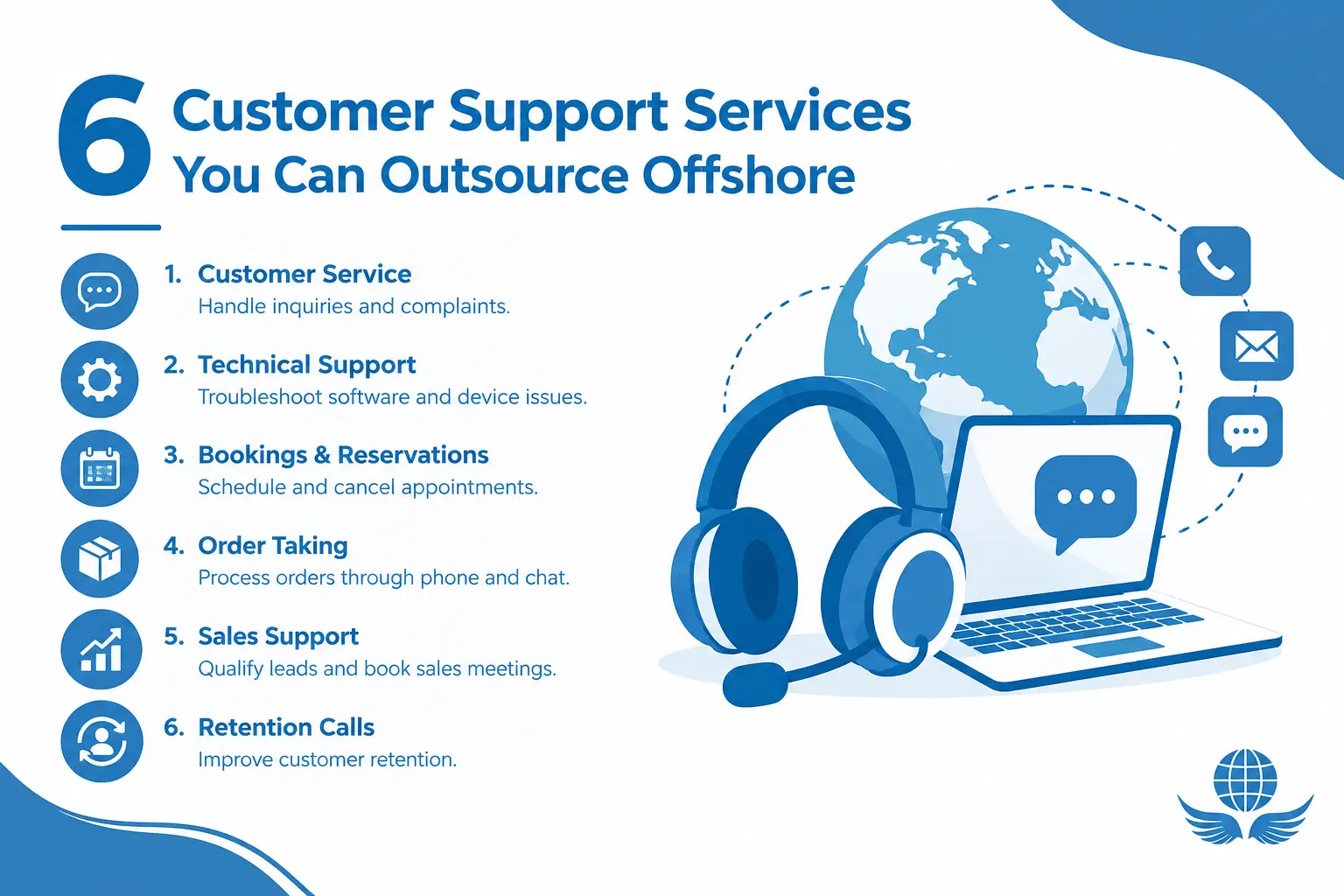
- Customer service: Ask order questions, update customer accounts and address complaints with customer service teams.
- Technical support: Provide technical support and troubleshoot Tier 1 software and devices.
- Bookings: Book, move, and cancel visits through booking and reservation systems.
- Order taking: Take orders via phone and chat, and secure payment through order-taking services.
- Sales support: Qualify leads and book meetings through sales support services.
- Retention calls: Conduct onboarding, welcome and retention calls.
Offshore IT outsourcing is a separate field focused on software development, so we don’t cover it here. Our focus is offshore customer support outsourcing and offshore call center outsourcing, where people talk to people.
How to Select the Correct Offshore Partner
The right partner will openly share its procedures before you sign. Ask each provider the same questions, and compare their responses. Take advantage of this checklist to help direct those talks.
What to look for:
- Native speakers of the language you need.
- PCI DSS and GDPR compliance, transparent data protection terms
- Low staff turnover and a healthy team-lead ratio.
- Live dashboards and reports you can mould with call recordings.
- Experience in your industry and with your systems
- Transparent pricing system in writing
- Flexible terms and a pilot option.
For reference, our agent attrition rate is 12%, and we offer term-based discounts.
Red flags:
- Sample calls or references not given
- Hidden setup or telecom charges
- No pilot or trial period
- Vague answers on data security
- Long minimum contracts with heavy exit penalties
Our RFI questions for call center outsourcing give you more to ask.
Case Study: Six Country Outreach for Global Consulting Firm
Problem: A leading management consulting firm based in New York needed to reach contacts in six countries on a tight timeline. The work required native speakers in several languages at once.
What we did: Our offshore team launched a multilingual outbound campaign by phone and text in Mandarin, Cantonese, German, French, Spanish, and English.
Outcome: The client achieved high customer satisfaction and met project objectives on a very tight schedule. We mobilized quickly and adapted to changing needs, their project manager said. Read the entire multilingual outreach case study or view our case studies.
Is Offshore Support Right for Your Business?
Offshore call center outsourcing suits clearly defined work with a regular workload.
It fits when you:
- Need 24/7 or overnight coverage
- Make consistent calls of the same type
- Are looking to reduce support hours without a reduction in support cost
- Want multiple languages from the site partner(s)
It may not fit when you:
- Receive only a few simple English calls each week
- Work on highly local or regulated work that needs to remain onshore.
- Lack documented processes to train agents on
If you have only a few English calls, an answering service for small businesses may be more appropriate.
Final Thoughts
Offshore outsourcing can lower costs, extend hours and add languages, but only with the right partner and clear controls. Set objectives, do a trial and assess quality weekly. Agents Republic is a Vancouver-based call center outsourcing Canada provider, with offices in Toronto and Budapest. We hold a BBB A+ rating and are PCI DSS- and GDPR-compliant.
See how our offshore outsourcing services can work for you. Call +1 (604) 210-8100 or contact our team to plan your program.
Frequently Asked Questions
What Are the Main Benefits of Offshore Outsourcing for Businesses?
Benefits include lower costs, a wider talent pool, 24/7 coverage, and faster scaling. Offshore outsourcing also lets your managers focus more on business growth and less on day-to-day employee management. Multilingual coverage is another advantage for an assistance team, as a single partner can likely support customers in multiple languages simultaneously.
How Much Can a Company Save by Outsourcing Offshore?
Based on our data, offshore savings are 60-80% compared to local staffing. This amount will vary depending on the job, hours, languages, and area you choose. Look at the entire monthly price (not just the hourly rate quoted by each provider) and include team leads, tools, and setup.
What Is Offshore Outsourcing Suitable for?
Yes, for many of them. Start with a few agents for set hours for a small team, then add more as volume increases. When it comes to hiring, startups tend to go offshore to avoid hiring too early. If English is the only language spoken and volume is very low, a minute-based answering service might be a more practical first step.
What is an Example of Offshore Outsourcing?
A clear example is a Canadian online retailer that utilizes a partner with agents in the Philippines for overnight support. The agents work during the day while Canadian customers sleep. The retailer gets 24/7 coverage without a local night shift, which is offshore outsourcing in practice.
What Are the Risks of Offshore Outsourcing?
The main concerns are language barriers, inconsistent quality, data security, time zone lag, and hidden costs. All of these are controllable. Implement native-speaker screening, standardized score sheets, PCI DSS and GDPR safeguards, overlapping hours, and a written fee schedule. A small test run before the big launch can also surface issues early.
What Is the Difference Between Offshore vs Nearshore Outsourcing?
Distance is the main difference between offshore and nearshore outsourcing. Offshore partners work in distant countries, have the largest time difference, and offer the lowest costs. Nearshore partners operate in neighbouring countries, with moderate costs and fewer time zone differences. Offshore is suitable for 24/7 coverage, while nearshore suits teams that require real-time collaboration with head office.
Which Countries Are Best for Offshore Outsourcing Services?
This depends on the language you require. The Philippines is one of the best places for English support because it has many experienced agents. For other languages, choose countries where native speakers use them. Match the country to your customers’ language, then check its security standards and its time zone overlap with your team.
How Long Does It Take to Set Up an Offshore Support Team?
Timing depends on team size, languages and systems. Before the pilot, a dedicated team goes through recruiting, background checks, system tests, and integration training. System links or longer training add time. Our common English answering plans are quicker and are completed online in 20 minutes or less.

