
Key Takeaways
- Germany, Austria and Switzerland share a language, but each market expects a different tone and set of rules.
- Even most online shoppers in Germany want to contact a person to resolve issues quickly.
- Swiss callers often speak dialect on the phone but expect replies in standard written German.
- German law requires simple online cancellation for consumer subscriptions.
- A dedicated team provides German support, priced by coverage hours rather than minutes.
Does your business meet the requirements for German buyers? Many Canadian businesses are already selling there. In 2025, Canada’s trade in goods with Germany totalled $34.3 billion. This makes Germany Canada’s top trade partner in the EU.
Sales are just the beginning. German customer service determines whether those buyers return. And one German script won’t work for customers in Berlin, Vienna, and Zurich.
This guide explains the differences between these markets and how to build support in all three.
Planning German coverage? Get a quote for your markets and channels.
What Does Good German Customer Service Look Like in the DACH Region?
In Germany, Austria and Switzerland, good service is transparent, unambiguous and verifiable. Customers expect a full answer on the first call, plus reference numbers, dates, and next steps to follow up on.
Tone is as important as accuracy. Agents greet customers with the formal form of address until the customer changes to another form.
Hamburg callers want to get a straight answer. Viennese callers want a warmer welcome. Callers in Zurich tend to speak in dialect on the phone. Local customs will also need to be taken into account, whether German cancellation rules or data protection in Switzerland.
Lastly, customers prefer to talk to a human being. Although chatbots can handle simple tasks, most users prefer a human for more complex issues. Overall, customers want a clear answer and a brand that backs it up.
How Do Germany, Austria and Switzerland Differ?
The three markets speak the same German, though with varying tones and vocabulary, and with different currencies and laws. The key points for the support team are listed below.
| Factor | Germany | Austria | Switzerland |
|---|---|---|---|
| Common tone | Direct and factual | Warm but formal | Formal and reserved |
| Spoken language | Standard German and regional accents | Austrian German | Swiss dialects |
| Written language | Standard German | Standard German with Austrian terms | Standard German with Swiss spelling |
| Currency | Euro | Euro | Swiss franc |
| Data law | GDPR | GDPR | Swiss Federal Act on Data Protection |
| Other languages | Rarely needed | Rarely needed | French and Italian in some regions |
| Time from Toronto | Six hours ahead | Six hours ahead | Six hours ahead |
Germany | Clear Answers and Documented Steps
Germans appreciate facts. They need information, the solution and a written record of the agreement. A fuzzy answer means more contact or a formal complaint.
They’re also looking for people, not just bots. About 62% of online shoppers in Germany prefer a human contact who responds quickly if there’s a problem. Only 36% would want a chatbot’s assistance.
Austria | Warmth Within a Formal Frame
In Austria, customers expect a friendly, kind tone, but casual words are not acceptable; titles are still used. When provided, agents should use the customer’s title, such as Dr.
In some months, foods and everyday objects have different names in Austrian German. A reply written for Germany can sound odd in Vienna. Cultural fluency means knowing these words. They help you communicate well regionally, not just with the right accent.
Switzerland | Dialect on the Phone, Standard German in Writing
Switzerland needs the most care. At home, 55% of people in Switzerland usually speak Swiss German, while 23% speak French and 8% speak Italian.
In the German part of Switzerland, people speak in dialect but write in standard German.
As a result, people prefer standard German customer service in Switzerland, which requires agents who know Swiss dialects over the phone and can communicate in correct written German.
In addition, Swiss spelling differs slightly from German spelling, and prices have to be in Swiss francs.
How Do You Deliver German Customer Support Across DACH?
Build one German operation with clear rules for each market. Then train every agent on those rules. The 7 practices listed below have the greatest impact.
Assign Agents by Market, Not Only by Language
Native German speakers from the right market sound local and pick up small signals of frustration. An agent from Munich may not follow a caller from Bern.
Our German call center services assign agents by the market they serve, so no one sounds out of place.
Start Formal and Let the Customer Lead
During all first contacts, use the formal “you”. It is the safe bet. Keep it for the whole call unless the customer switches first. This protects the brand from sounding careless.
Write Replies Customers Can Check
Avoid these promises in all three markets. Provide the case number, the date of each promise, and the next step in writing.
Write a summary after every phone call. This habit alone decreases repeat contacts.
Keep a Human Within Reach on Every Channel
Allow phone, email, chat, and social media and maintain a single history. That’s what omnichannel support is all about.

Even though a chatbot can answer questions about order status, it should refer to a human for more complicated issues.
Make Cancellation Simple and Respectful
As of July 1st 2022, businesses in Germany must provide an online link to cancel subscriptions. So, agents must process a clear cancellation request. They should never block it.
You can still make an offer to keep the customer, but only after you confirm the request. Retention calls can then make that offer.
Adapt Content for Each Market
Language localization means rewriting macros, help pages and menus for each market. Review currency, spellings, holidays, and return policies.
Many holidays in Germany and Switzerland vary by state or canton. So plan staff around the customer’s region.
Give Technical Questions the Detail They Deserve
When customers buy software or machines, they demand precise answers. Trust is essential and can be lost quickly through guesswork. First-line agents record each fault in full before passing it on.
Our technical support team writes cases to the standard a German engineer expects.
How Should Canadian Businesses Staff German Customer Support?
Central Europe is six hours ahead of Toronto and nine hours ahead of Vancouver. A German customer calls at 9:00 am, and a team in Vancouver gets it at midnight.
So, for a Canadian business, it is essential to have a team working European hours. Night shifts don’t last long.
| Staffing Model | Best For | MaiIn-houseck |
|---|---|---|
| In-house team in Canada | Very low German volume | Hard to cover European business hours |
| Long-term | Recruitment, payroll and legal setup in each country | |
| Outsourced dedicated German team | Growing programs across all three markets | Needs a clear handover of product knowledge |
| Shared English answering service | Simple English calls only | No German coverage |
Outsourcing German-speaking customer support works well for many brands because it brings in a team familiar with the market. Some programs require English as well. Our bilingual customer service teams handle German and English callers in one queue, with one dashboard.
To launch German language support, follow these six steps:
- Map your customers. Tag recent tickets by country and language.
- Set coverage hours. Match the European business times for each market.
- Choose channels. Choose phone, email, chat, and social media.
- Adapt your content. Write new policies and macros per market.
- Train and certify agents. Cover your product, tone, and escalation rules.
- Launch and coach. Monitor the launch day and coach weekly for response time and resolution.
How Do You Measure DACH Customer Service?
Apply a different measurement for each country. A composite score can disguise a poor Swiss queue and a good German queue.
- Follow the indicators below by market:
- Measure customer satisfaction by country and channel, not as a single number.
- First contact resolution, since customers do not want to repeat themselves.
- Written quality, scored by native reviewers for grammar, spelling, and tone.
- Handling of cancellation – to ensure that each request is processed properly.
- A high percentage of repeat purchases is a clear sign of customer loyalty.
Our look at French and German support shows why each market needs its own scorecard.
How Is German Customer Care Priced?
We price German customer care based on the hours required to cover it, because it runs on a dedicated team.
Our shared 24/7 answering service uses minute-based plans and covers English calls only. It suits simple, lower-volume needs, not German work.
The formula for dedicated German teams is clear:
- The hourly rate charged by the agent
- Multiplied by the coverage hours you agree on
- Plus a monthly fixed supervision fee.
The hourly rate depends on where the agent works, their skills and the language. If you use your own CRM and tools, you usually pay no additional fees. You purchase additional equipment, like a telephone system, separately.
Ready to see your numbers? Call +1 (604) 210-8100 and share your volumes.
How Does Agents Republic Support German-Speaking Customers?
Agents Republic is a Canadian company. Our head office is in Vancouver, with a sales office in Toronto and an office in Budapest. Our call center services support clients in Canada, the U.S. and Western Europe.
Our German support services staff each country with its own agents. You can add French and Italian under one contract for Swiss programmes, and our French call centre services cover French-speaking areas.
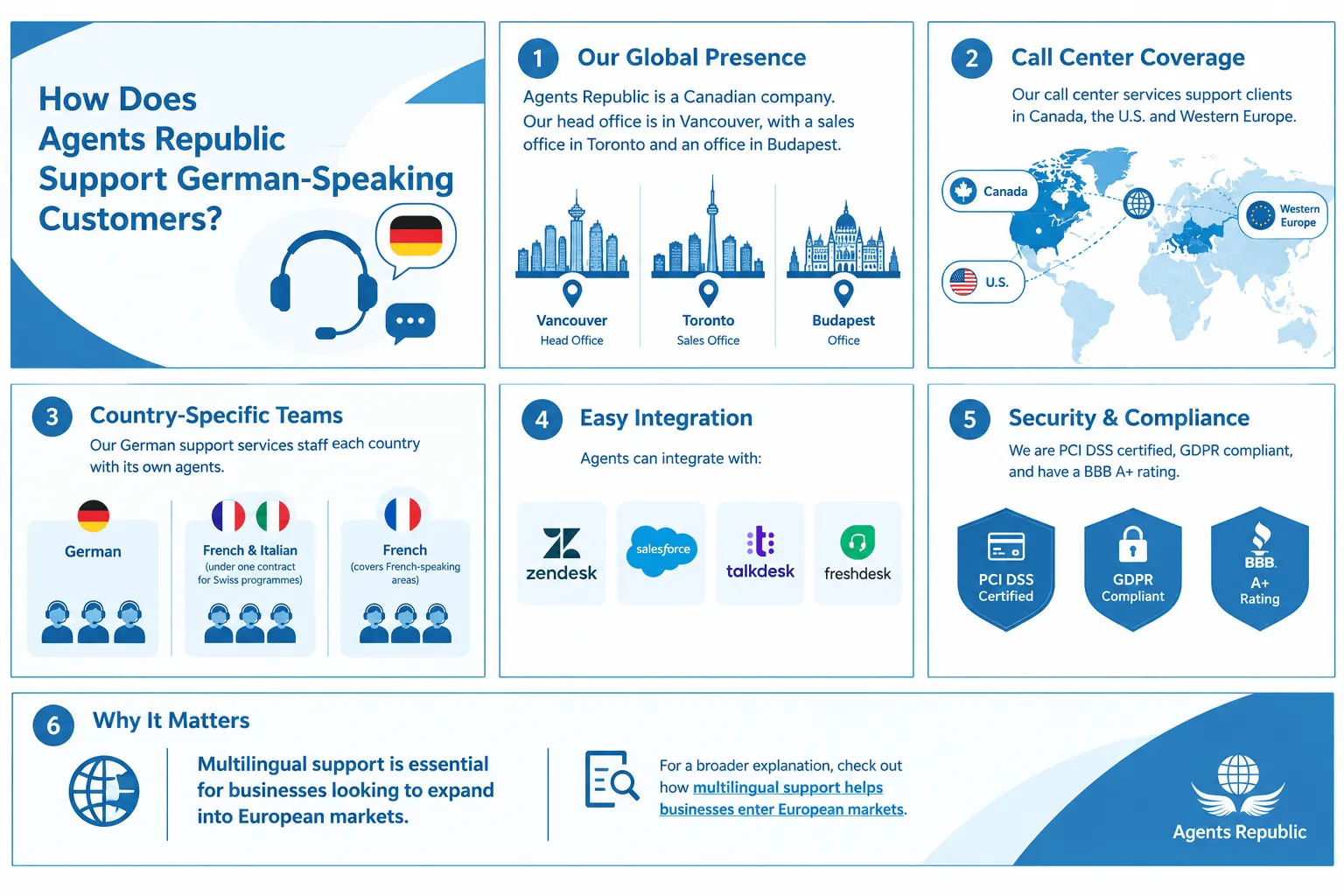
That makes it easier to manage a multilingual customer service as you expand. Agents can integrate with Zendesk, Salesforce, Talkdesk, or Freshdesk. We are PCI DSS certified, GDPR compliant, and have a BBB A+ rating.
Multilingual support is essential for businesses looking to expand into European markets; for a broader explanation, check out how multilingual support helps businesses enter European markets.
Final Thoughts
German customer service is local, precise and polite. It maintains a formal style, caters to every market, and provides customers with answers they can verify.
For Canadian companies, this also means native agents cover European hours. Get these basics right, and the German customer experience gives buyers a reason to stay.
Are you prepared to meet all your customers’ needs in Germany, Austria and Switzerland? Call +1 (604) 210-8100 to plan your German team today.
Frequently Asked Questions (FAQs)
Can Swiss customers be supported in Swiss German?
Most Swiss callers have Swiss German as their home language and use it frequently on the phone. Written responses are typically expected in standard German, with Swiss German as an option.
The ideal setup is agents with dialect knowledge who can respond clearly in standard German. Agents from Switzerland are best suited, especially for spoken calls and local terms.
Can one German team represent Germany, Austria, and Switzerland?
Yes, for simple and low-volume work. A proficient team can tailor the tone to each market.
With market-specific agents, you get better results. Swiss callers need to know dialects, Austrian callers need local terms, and different markets have different holidays, currencies, and legal rules.
What languages should a Swiss support program have?
This depends on where your customers are located. German is the most widely spoken language; French and Italian are also national languages.
All three should be considered in a Swiss program that is sold nationally. German and French are the bases for many brands, followed by Italian when volume in the south warrants a separate agent.
What hours should a Canadian company cover for DACH customers?
The minimum is Central European business hours. In Toronto, that’s approximately 3 a.m. to 11 a.m., and in Vancouver, it’s midnight to 8 a.m.
Many brands in Europe are also available on Saturdays and in the evening. Partnering with agents who work local European hours keeps you from costly night shifts for your own Canadian staff.
Do German customers accept chatbots?
They’re okay with chatbots for basic tasks like order status or hours. Most still prefer a human for real problems. A chatbot should promptly transfer the customer to a human and include the full chat history.
German customers hate repeating themselves and appreciate an explicit, documented answer from a responsible person.

